
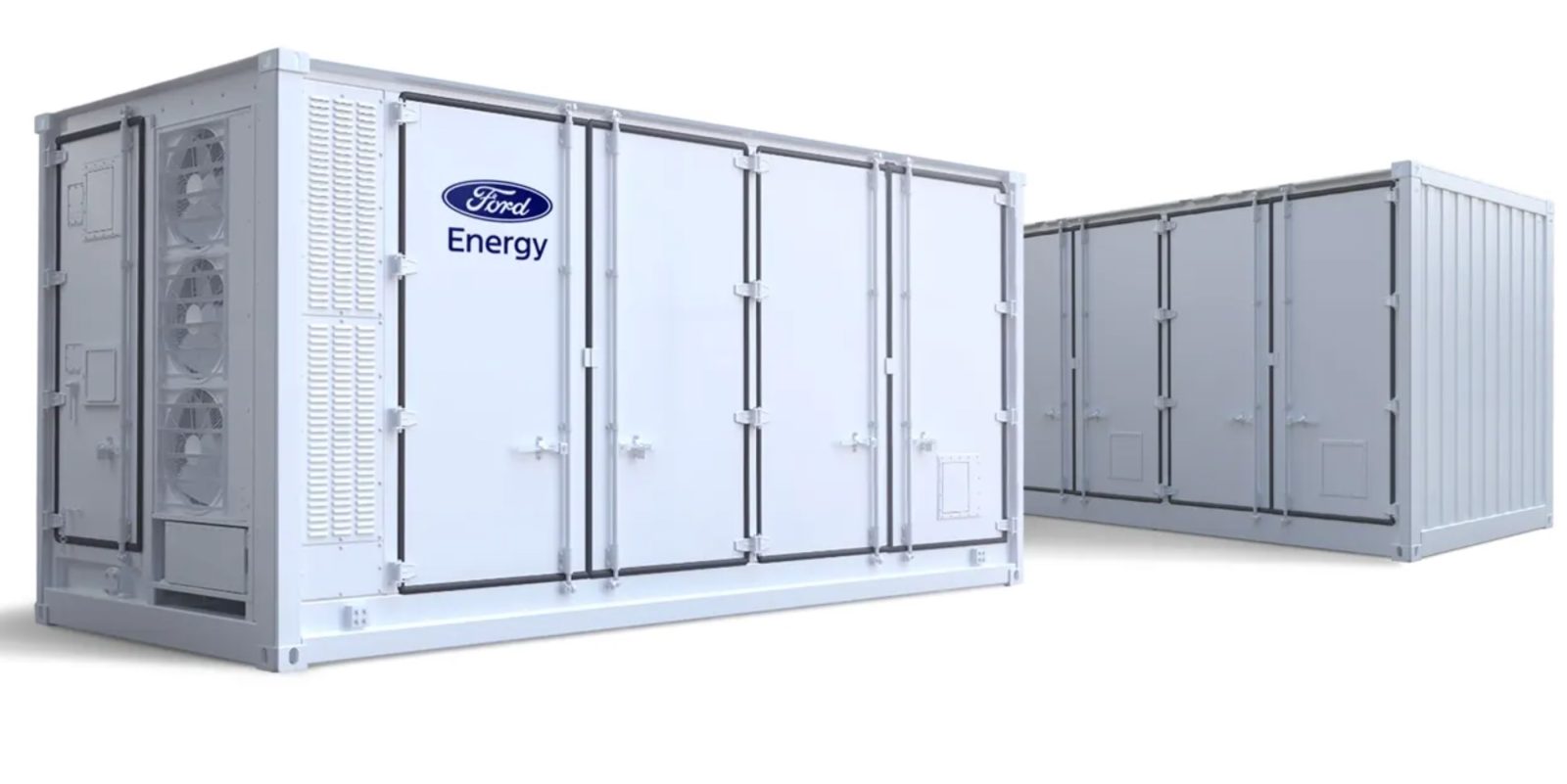
Ford has officially unveiled Ford Energy, a wholly owned subsidiary that will manufacture and sell U.S.-assembled battery energy storage systems (BESS) for utilities, data centers, and large industrial customers. The new unit plans to produce 20 GWh of energy storage annually from its Kentucky gigafactory.
The move formalizes what has been months in the making — Ford’s pivot from struggling EV battery overcapacity to the booming grid-scale energy storage market, where demand is surging thanks to AI data centers and renewable energy buildout.
From EV battery overcapacity to energy storage play
Ford Energy didn’t come out of nowhere. As we covered in December, Ford announced plans to convert its EV battery plants to make battery storage for data centers after it became clear that demand for EV batteries wasn’t absorbing the capacity Ford had built. That announcement came just days after Ford and SK On killed their massive $11.4 billion BlueOval SK joint venture, splitting their battery factories between the two companies.
Ford Energy President Lisa Drake, who was appointed to lead the new subsidiary in January, said the company has been building quietly toward this launch. In a blog post, she wrote that the team has spent the better part of a year “executing — securing supply chains, readying our manufacturing sites and aligning our technology with the massive demand for domestic energy storage.”
The subsidiary will operate out of Ford’s Glendale, Kentucky facility — the same plant that was originally built for EV battery production under the BlueOval SK joint venture. Ford now wholly owns the Kentucky operations and is repurposing them into what it calls a gigafactory for energy storage production.
The flagship product: Ford Energy DC block
Ford Energy’s flagship product is the DC block, a standardized 20-foot containerized battery energy storage system built around 512 Ah LFP prismatic cells. It comes in two configurations:
The FE-250 is a two-hour system, and the FE-450 is a four-hour system. Both deliver 5.45 MWh of rated energy capacity, operate across a 1,040-1,500 VDC voltage range, and integrate liquid-cooled thermal management with a proprietary battery management system.
The spec sheet reveals a system designed for harsh environments: an operating temperature range of -35°C to +55°C, IP55 ingress protection, C5 corrosion protection, and operation at altitudes up to 4,000 meters without derating. Each unit weighs approximately 43.5 tonnes and fits a standard 20-foot shipping container footprint.
Ford is emphasizing the LFP chemistry choice — the same lithium iron phosphate technology that has dominated the grid-scale storage market globally. LFP offers better thermal stability and longer cycle life compared to NMC alternatives, which matters for a product Ford says is designed for 20-year performance.
First customer deliveries are planned for late 2027.
Competing with Tesla’s Megapack in a booming market
Ford Energy is entering a market that Tesla currently dominates. Tesla deployed a record 46.7 GWh of energy storage in 2025 — nearly 50 GWh in a single year. Its upcoming Megapack 3 — set for volume production later this year from its Houston gigafactory — will offer 5 MWh per unit with a planned 50 GWh annual production capacity.
Ford’s 20 GWh annual target is significant but still less than half of Tesla’s planned Megapack production. However, the market is massive and growing fast. The U.S. is expected to add 24 GW of new utility-scale battery storage in 2026, nearly double the record 15 GW added in 2025. Industry projections call for over 600 GWh of energy storage on the U.S. grid by 2030.
Data center demand is a particularly strong tailwind. AI infrastructure buildout is driving unprecedented electricity demand, and battery storage is increasingly viewed as critical for grid stability and power reliability. Data centers could account for 83% of behind-the-meter commercial and industrial storage deployments by 2030.
Ford is also betting on its domestic manufacturing angle. The company highlights that its systems are assembled in the U.S., designed to facilitate Section 48E Investment Tax Credit eligibility, and built with a supply chain strategy aimed at meeting domestic content requirements. In the current trade environment, that positioning could be a meaningful differentiator against Chinese BESS manufacturers.
Electrek’s Take
We haven’t been a fan of Ford’s EV pullback over the last year, but this is a smart utilization of the battery capacity that it built with SK. The company invested billions in battery manufacturing capacity through the BlueOval SK venture, then walk away. Rather than letting those factories sit idle, Ford is redirecting that capacity toward a market where demand is genuinely outstripping supply.
The 20 GWh annual capacity target is ambitious for a new entrant, but Ford has the manufacturing infrastructure already in place — it doesn’t need to build a factory from scratch like many competitors. The LFP chemistry is the right call for stationary storage, and Ford’s emphasis on U.S. assembly and domestic content eligibility addresses a real concern among utility buyers navigating trade uncertainty.
The challenge is execution timeline. Late 2027 deliveries mean Ford is still more than a year away from shipping product, and Tesla will have its next-generation Megapack 3 in volume production by then. Ford also hasn’t disclosed pricing, which will be critical in a market where cost per MWh is the primary purchase decision driver. But in a market projected to need hundreds of GWh of new capacity this decade, there’s room for more than one major player — and Ford’s 122-year manufacturing pedigree gives it credibility that most BESS startups can only dream of.


FTC: We use income earning auto affiliate links. More.




Comments